Fitzpatrick skin types: which of the six is yours?
Since 1975, dermatologists have grouped skin into six “photo-types” by how it reacts to ultraviolet light. Your type shapes how fast you burn: under the same Australian sun, a type I can burn several times faster than a type V. It’s the reason one-size-fits-all sun advice undersells the risk for some and oversells it for others.
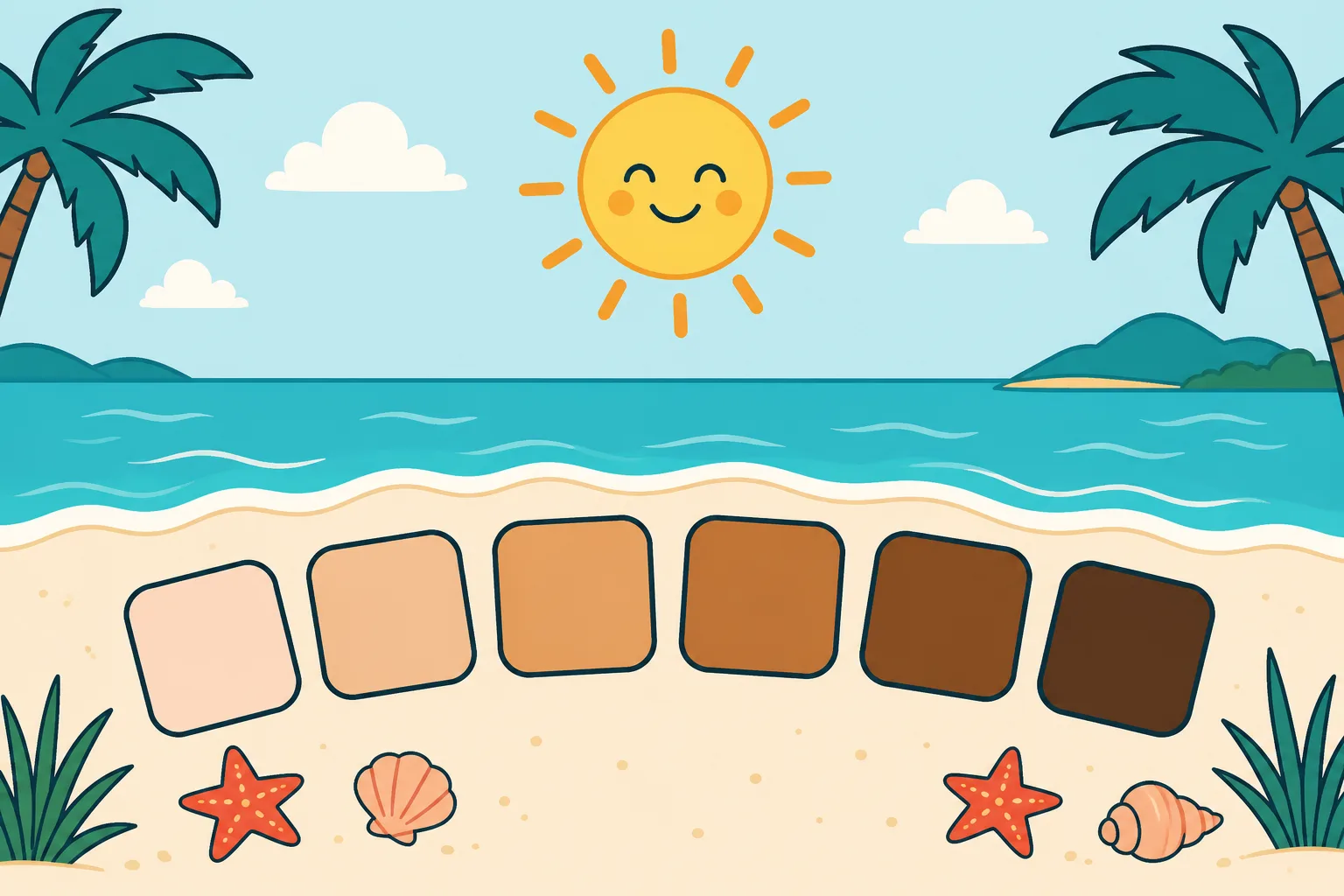
The six types
| Type | Typical features | Sun reaction |
|---|---|---|
| IVery fair | Pale skin, often freckles; frequently red or blond hair | Always burns, never tans |
| IIFair | Fair skin; blue, green or hazel eyes common | Burns easily, tans minimally |
| IIILight to medium | Cream to light olive skin | Sometimes burns, tans gradually |
| IVOlive to tan | Olive or light brown skin | Rarely burns, tans easily |
| VBrown | Brown skin | Very rarely burns, tans deeply |
| VIDeep brown to black | Deeply pigmented brown to black skin | Almost never burns |
Each type has its own full guide: type I, II, III, IV, V and VI , with identification cues, burn times under Australian UV and what actually matters for each. Not sure which is you? Take the two-minute quiz.
Why your type changes your burn time
Each type has a different threshold of UV exposure before skin reddens (the “minimal erythema dose” used in dermatology research). Combine that threshold with the live UV index and you get a rough guide to how long unprotected skin can be in the sun before it starts to burn: minutes on an extreme Australian summer day for fair skin. That’s the estimate Sunwise calculates from a photo.
One thing your type never changes: when UV is 3 or above, everyone benefits from Slip, Slop, Slap, Seek, Slide. See the sun safety guide. And no skin type is immune to skin cancer: check your skin and see a doctor about anything new or changing, whatever your tone (Melanoma Institute Australia has excellent self-check guides).
Frequently asked questions
- What is the Fitzpatrick scale?
- A classification developed by dermatologist Thomas Fitzpatrick in 1975 that groups skin into six photo-types (I–VI) by how it responds to ultraviolet light, from always burns, never tans (type I) to almost never burns (type VI). Dermatologists still use it to talk about sun sensitivity.
- Do darker skin types need sun protection?
- Yes. Deeper skin tones burn far more slowly, but every skin type can burn, sun-damage accumulates, and skin cancer occurs across all types, where it is often detected later on darker skin. Cancer Council recommends sun protection for everyone when the UV index is 3 or above.
- How does Sunwise estimate my skin type?
- Sunwise analyses a photo of the inside of your upper arm using the Individual Typology Angle (ITA°), a colour measurement used in dermatology research, and maps it to an approximate Fitzpatrick type. The inner arm is a standard site for constitutive (untanned) pigmentation, more stable than a tanned belly or face. It's a rough educational estimate, not a clinical assessment; lighting and camera colour affect the result.
Go deeper
- The 2-minute skin type quizThe standard self-assessment dermatologists use.
- How to tell if you have fair skinBurn history beats mirror colour, the real signs.
- ITA°: measuring skin tone objectivelyThe colour angle behind the Sunwise photo check.
- Where the Fitzpatrick scale fails darker skinThe scale's history, its blind spots, and what's better.
Find your type in about a minute.
One photo, analysed in memory and discarded. Free, no account.
Estimate my skin type